How can one indoor park work for younger and older children?
Plan different levels of play without making the family visit feel disconnected.
Picture a family arriving with two children. One wants to crawl, climb a small slope and repeat a familiar slide. The other has already spotted a higher route and wants to explore without following a parent at every step. Both are excited. Their parent is now trying to work out how to keep track of them.
This is why planning for different ages means more than marking one corner “toddlers” and another “older children”. Children need different challenges, while families need clear routes, places to rest and an easy place to meet again. Parents should not have to spend the visit working out where everyone is.
01Start with your main visitors, not every possible age
It is easy to ask a small park to serve toddlers, school-age children, teenagers and adults equally. In practice, each group brings different needs. Before dividing the plan, decide who the park is primarily for and who is likely to accompany them.
Age helps explain the audience, but it is not the only consideration. Confidence, ability, height restrictions and the character of each activity also matter. An older child may prefer a gentler route; a younger child may be eager to attempt something that is not suitable for them. Planning and operating rules need to work together rather than relying on age labels alone.
02Put toddler play close to the adults who care for them
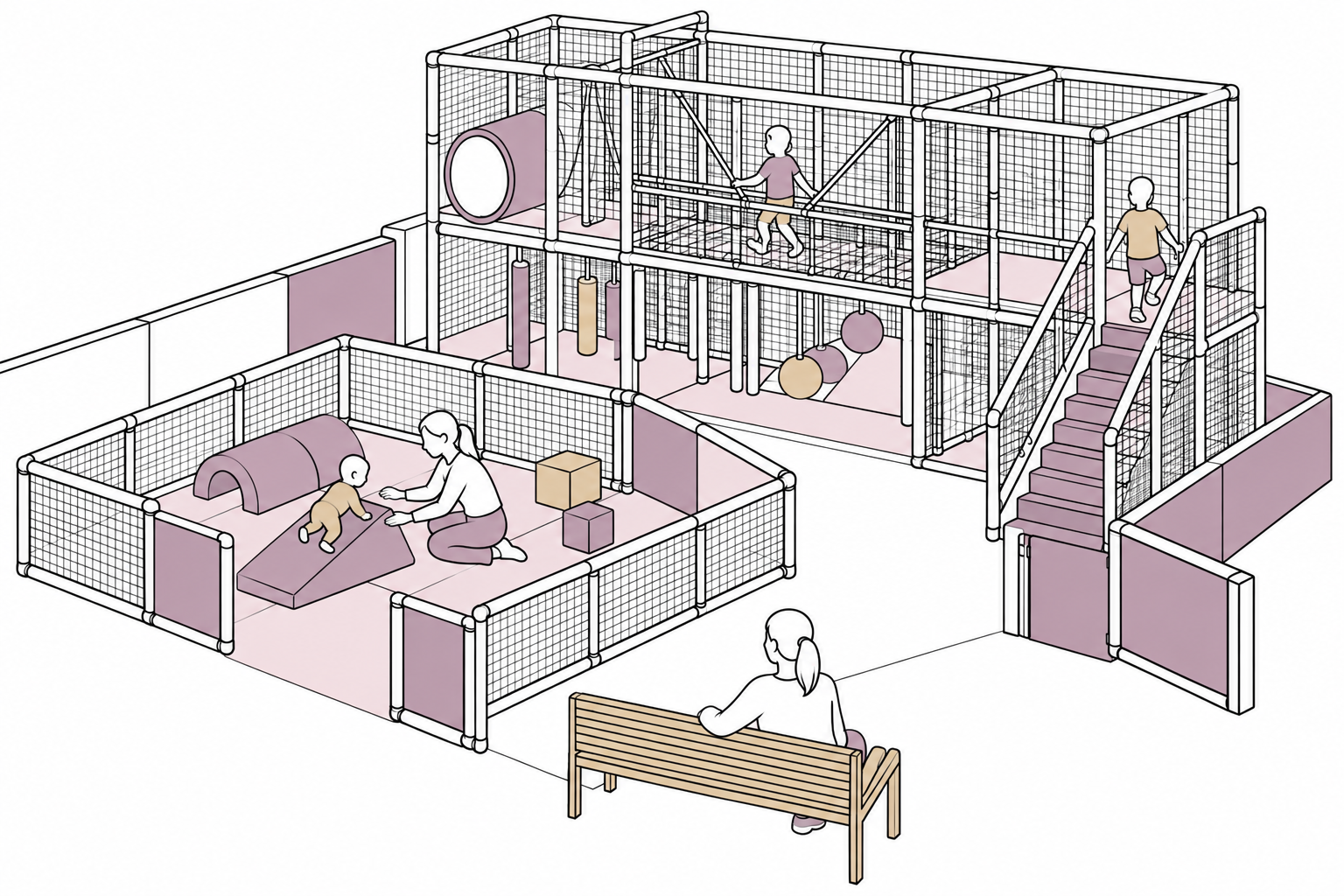
For younger children, the distance between “I can see you” and “I can help you” is important. Locate the toddler area near parent seating, with a clear view and a convenient route for an adult to step in. A seat beside a zone is less useful if a decorative wall blocks the view or its entrance is on the far side.
Check the height of barriers, the position of entrances and what an adult can see while sitting down. The toddler area should not become a shortcut for children running towards a slide or another activity. Give it a clear boundary and a suitable entrance, while keeping it easy to see inside.
Nearby seating helps parents watch their children, but the area still needs supervision. Parents must follow the park’s rules. The operator must also provide suitable staff, checks and procedures.
03Let older children explore without disappearing from view
Multi-level soft play gives school-age children different routes to explore on their own. For example, a park may plan an area for children aged eight to twelve, subject to the equipment’s actual limits. Parents should still be able to see into the structure.
Too many solid decorative panels can block the view. We aim to create an attractive theme without hiding the play areas. Where suitable, we use netting or transparent panels and place decorations carefully. We check whether adults can see entrances, connections between levels and main activity areas.
We also plan how adults can get inside. Parents, staff helping a child and cleaning staff all need suitable access. This does not mean every children’s tunnel must fit an adult. It means there must be a planned way to reach the areas where help or cleaning is needed. Plan these routes before adding decoration.
Three relationships to check on the plan
- Toddler area ↔ seatingShort, clear access and useful views from a seated position.
- Older-child play ↔ observationOpen views into key areas, with considered adult and staff access.
- Separate zones ↔ family meeting pointAn understandable route to pause, reconnect and leave together.
04Keep running routes away from entrances and waiting areas
Problems often happen where activities meet. Children may run past a toddler entrance, a queue may block the family rest area, or people may walk across a slide exit. The layout should help keep these movements apart.
Walk the imagined plan at a busy time. Where will children run? Where will somebody stop to decide what to do next? Where might a younger child step into an older child’s path? Use layout, clear boundaries and operating rules to reduce these conflicts. Sightlines help adults notice problems earlier, but they are one part of a wider safety approach—not a guarantee that incidents cannot happen.
05Share the visit, not necessarily every activity
Families do not need every child to use every product together. They do need places and moments that connect the visit. A shared arrival point, a comfortable pause, an easy-to-find meeting location and suitable family activities can make distinct zones feel like one park.
Some interactive games let family members play together. Check how each game works: do people cooperate, take turns or play side by side? Are its pace and rules suitable for your visitors? The word “interactive” alone does not tell you whether a game suits every age.
06Test the plan from a parent’s position
Follow a parent from a seat to the toddler entrance, then to the older child’s play structure. Is the route easy to find? Can they get there without crossing an active play area? Can they see where their child has gone? Is there a clear place for the family to meet?
There will rarely be one seat with a complete view of every level. Do not promise that. Instead, identify the important observation points and make movement between them straightforward. Review the plan from seated and standing positions, then verify the actual views when structures and decoration are installed.
07In a small park, focus on your main age group
When space is limited, focus on good play options for your main age group. This may work better than adding one small activity for each age group. The Bazillion case study in Bobruisk shows several types of play in a compact park. Look at how the activities connect. Your park may need a different layout and different age zones.
Start by telling us which ages you want to serve, how parents will accompany their children and how many staff will be available. We can then discuss suitable activities, places to rest, clear views and easy access.